

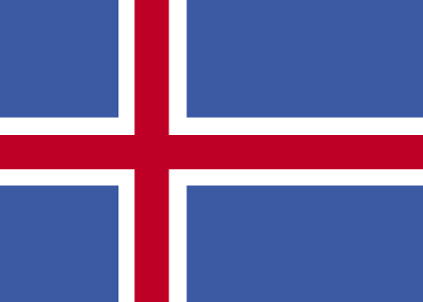
Country Language:
Icelandic
Country Currency
(ISK) Iceland Krona
Location
Country Labor Law References & Information
| Law / Regulation | Link | Description |
|---|---|---|
| Act on Trade Unions and Industrial Disputes (No. 80/1938) | asi.is | Establishes the legal framework for trade unions, collective bargaining, strikes, and the Labour Court. |
| Act on Working Terms and Pension Rights Insurance (No. 55/1980) | government.is | Stipulates that collective agreements set minimum employment terms applicable to all workers. |
| Act on Equal Status and Equal Rights of Women and Men (No. 10/2008) | government.is | Prohibits gender-based discrimination and mandates equal pay for equal work. |
| Act on Equal Treatment in the Labour Market (No. 86/2018) | government.is | Prohibits discrimination in employment based on various characteristics, including sexual orientation and gender identity. |
| Act on the Working Environment, Health and Safety in Workplaces (No. 46/1980) | vinnueftirlit.is | Governs occupational health and safety standards in workplaces. |
🏛️ Official Government Sources
| Institution | Link | Role |
|---|---|---|
| Government of Iceland – Labour Market and Employment | government.is | Provides information on labour laws, employment rights, and related legislation. |
| Icelandic Confederation of Labour (ASÍ) | asi.is | Represents workers and offers resources on collective agreements and labour rights. |
| Directorate of Labour (Vinnumálastofnun) | vmst.is | Manages unemployment benefits, work permits, and labour market measures. |
| Administration of Occupational Safety and Health (Vinnueftirlitið) | vinnueftirlit.is | Oversees workplace health and safety regulations and enforcement. |
Labour Law in Iceland
Iceland’s labour framework is built on a foundation of strong social dialogue, universal collective bargaining, and progressive equality principles. It combines Nordic pragmatism with robust legal protections, ensuring that employment relationships are clearly regulated while maintaining space for flexibility and trust between workers and employers.
At the heart of Icelandic labour law is the principle that collective agreements determine minimum employment conditions. These sector-wide agreements—negotiated between unions and employer associations—carry the force of law and apply to nearly all employees, whether unionized or not. This model ensures wage transparency, sectoral cohesion, and predictable terms across the workforce.
Legal protections are further reinforced by targeted legislation addressing key rights: equal pay, non-discrimination, health and safety, and fair treatment in the workplace. Oversight is shared among well-established public bodies: the Directorate of Labour manages work permits and unemployment support, while the Administration of Occupational Safety and Health ensures compliance with workplace standards.
Importantly, Iceland’s laws reflect a strong commitment to social equity. Employers are legally obligated to implement equal pay certification processes, and discrimination based on gender, ethnicity, or orientation is expressly forbidden under multiple statutes. This rights-based approach is not only cultural—it is embedded in regulation and actively enforced.
In sum, Iceland’s labour law system reflects a balance of modern legal rigor and collaborative industrial relations. It offers a clear and protective environment for both domestic and foreign workers, supported by accessible public institutions and widely respected collective mechanisms.
The Most Popular Job Boards in ICELAND
| Platform | Link | Description |
|---|---|---|
| Alfreð | alfred.is | A leading job portal in Iceland, offering a wide range of job listings across various sectors. Users can create profiles, upload CVs, and apply directly through the platform. |
| Job.is | job.is | One of Iceland’s oldest online job boards, providing a broad spectrum of job opportunities, including specialist positions. |
| Vinnumálastofnun (Directorate of Labour) | vmst.is | The official government employment service, listing vacancies across all sectors and providing resources for job seekers. |
| Störf.is | storf.is | A job aggregator that compiles listings from various sources, offering a comprehensive view of available positions in Iceland. |
| Starfatorg | starfatorg.is | Focuses on public sector job listings, including positions in healthcare, education, and administration. |
| Tvinna | tvinna.is | Specializes in creative and tech industry jobs, featuring roles in design, IT, and media. |
| HH Ráðgjöf | hhr.is | A recruitment agency offering job listings and career services, primarily in Icelandic. |
| EURES Iceland | eures.is | Part of the European Employment Services network, providing job listings and information for job seekers interested in working in Iceland. |
| linkedin.com/jobs | A global professional networking platform where Icelandic employers post job openings across various industries. |
Job Boards in Iceland
Iceland’s job market is supported by a combination of official government platforms, specialized job boards, and recruitment agencies. The Directorate of Labour (Vinnumálastofnun) serves as the primary public employment service, offering a comprehensive list of vacancies and resources for job seekers.
For those seeking opportunities in specific sectors, platforms like Alfreð and Job.is provide extensive listings across various industries. Tvinna caters to the creative and tech sectors, while Starfatorg focuses on public sector roles. Störf.is aggregates job postings from multiple sources, offering a broad overview of available positions.
International job seekers can benefit from EURES Iceland, which provides information and listings tailored to those looking to work in Iceland. Additionally, LinkedIn is increasingly used by Icelandic employers to reach a global audience.
Recruitment agencies like HH Ráðgjöf offer personalized services and can be a valuable resource for job seekers looking for specialized roles.
Iceland’s job board landscape is diverse and accessible, providing multiple avenues for job seekers to find suitable employment opportunities across various sectors.
This page is intended as a general reference guide to the most commonly used job boards and key employment-related resources in the country, including links to local labor laws where available. While HR DADA strives to keep this information current, we update these listings periodically to reflect changes in market trends, platform relevance, and regulatory updates. For the most accurate and tailored guidance, whether for compliance, recruitment strategy, or HR market entry, we recommend reaching out directly to the HR DADA team via chat space.crew@hrdada.com.


