Let’s set the stage.
A candidate with 15 years of experience.
A public track record.
Visible outcomes. Recognized leadership. Recommendations you didn’t even have to ask for.
And what do you do?
You send them a 2-hour logic test, a timed aptitude game, and a “cognitive challenge” designed to filter for… what, exactly?
This isn’t rigor. It’s redundancy. It’s HR theatre.
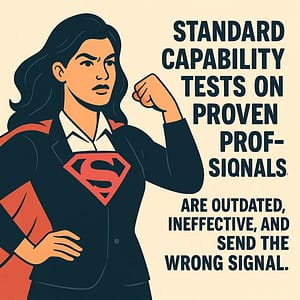
Capability assessments have their place in the early-career, high-volume, role-specific hiring where signals are scarce and skills need validation.
But when you use them on proven professionals, it stops being about assessment.
It becomes a power move. A test of compliance, not capability.
You’re not measuring potential. You’re measuring how much someone is willing to put up with to join your bureaucracy.
And the message it sends? Loud and clear:
“We don’t trust what you’ve done. We only trust our process.”
Even when that process is designed for entry-level analysts, not executive operators.
Even when it ignores context, ignores human nuance, ignores common sense.
You wouldn’t give a concert pianist a beginner’s sight-reading test.
You wouldn’t ask a published author to write a 500-word blog sample.
So why are you giving seasoned, visible professionals generic skill tests based on models built for mass filtering?
Worse, why are you asking them to prove themselves to a system that doesn’t even understand what they actually do?
It’s not due diligence.
It’s process inertia.
And it’s costing you credibility.
Here’s what high-caliber talent thinks when you send that link:
Not “Wow, what a rigorous culture.”
But:
“They don’t know how to hire at this level.”
“They don’t know what they’re looking for.”
“They treat everyone like a risk.”
And if they’re really good?
They won’t say no.
They just won’t say anything.
They’ll vanish.
Want to assess senior talent?
Talk to them.
Check references.
Look at outcomes.
Listen for thinking.
Match to strategic needs, not gamified proxies for intelligence.
Because the real capability you should be testing is your own, to spot experience without defaulting to templates.
And if you’re still using entry-level hiring frameworks to assess senior professionals, here’s what it really shows:
“you really don’t know how to hire experienced professionals.”
What works for early-career talent: standardized tests, logic puzzles, automated screenings, falls apart when applied to someone with a visible track record. Senior hiring requires a different muscle. It’s not about filtering for basic skills. It’s about aligning values, judgment, and strategic capability.
When experienced professionals are asked to “prove themselves” through generalized capability assessments designed for beginners, it sends the wrong message: that your process hasn’t matured. That you’re more comfortable outsourcing decisions than making them. That you treat lived experience as anecdotal, and algorithms as absolute.
The result? The very people you’re trying to attract will quietly step back. Not because they can’t do the job, but because they know you’re not ready to hire someone who already has.
If your hiring process can’t recognize expertise when it walks in the door, the problem isn’t your candidates.
It’s your system.
What 15+ Years of Experience Actually Represents
By the time someone reaches this level, they’ve moved beyond proving functional knowledge. What they’ve gained isn’t just time. It’s compound credibility. Hard-won lessons. Depth you don’t get from a book or a certificate.
Here’s what 15 years often includes (and this is conservative):
- Leading cross-functional projects with millions in budget and impact
- Managing diverse teams, both directly and through matrix orgs
- Navigating complex stakeholder environments, internally and externally
- Coaching others into leadership roles
- Handling crises that don’t fit templates
- Building systems from scratch, or repairing the ones that were broken
- Running hiring processes themselves, often many times over
- Owning P&Ls, strategy rollouts, restructures, integrations
- Presenting to exec boards, regulators, investors, and skeptical teams
- Seeing tools come and go, but keeping the human outcomes intact
- Managing people through burnout, exits, failures, and change
- Writing the policy, not just following it
And on top of that?
They’ve probably already completed dozens of case studies, psychometric tests, capability assessments, and whiteboard exercises over the course of their career. Not to mention the informal vetting that happens in every performance review, promotion panel, client renewal, and strategic offsite.
Yet We Still Ask Them to “Prove It” Again
We send 3-part tests with 48-hour deadlines.
We request unpaid “homework” before they even meet a decision-maker.
We say it’s “standard process” and expect them to be impressed by our thoroughness.
Here’s what they actually hear:
“We don’t trust your experience.”
“We’d rather watch you jump through hoops than study your actual outcomes.”
“Our process is designed for people we don’t know how to evaluate, so we’ll treat you the same.”
It’s not rigorous.
It’s lazy.
And it drives away the exact kind of people you want to hire.
At This Level, You’re Not Just Hiring Skills – You’re Hiring Judgment
15 years in, the questions change.
You’re not asking: “Can they do the job?”
You’re asking:
- “Can they lead others to do it?”
- “Can they spot what’s broken before it fails?”
- “Can they balance trade-offs in motion?”
- “Can they step back and architect the right systems, not just react to symptoms?”
And here’s the thing: none of that shows up in a standard capability test.
Because these are questions of pattern recognition.
Emotional intelligence.
Scar tissue.
Insight.
You don’t test those with a slide deck.
You find them in conversation, context, and trust.
The Real Test Is on the Hiring Side
Are you ready to hire someone smarter than you in a specific domain?
Are you prepared to let go of control and let someone lead?
Are you comfortable recognizing that what they’ve built, learned, failed at, and survived has already been the real case study?
If not, don’t blame them for declining your “take-home challenge.”
They’re not avoiding rigor.
They’re avoiding a broken process that can’t see past templates.
What You Should Do Instead
If you’re hiring a senior professional: VP, Director, Principal, Head of, Expert or Manager (basically any role where candidate is already proven above specialist level), your process should look like “leadership”, not bureaucracy.
- Review their real work. Portfolios, strategy docs, public talks, outcomes.
- Talk to people who’ve worked with them. Not just titles, ask how they led.
- Create real dialogue. Strategic conversation beats timed assignments, every time.
- Evaluate how they think in context, not how fast they solve hypothetical math.
- Respect their time. The best people are in demand. Treat them like it.
Because if your hiring process doesn’t reflect the level of the role, you’ll never fill it with the caliber of talent it deserves.