Have you ever witnessed an act of unnecessary police brutality, or seen authority abused so blatantly it was painful to watch, and asked yourself: how on earth did this person ever get the job, and who allowed them to hold such power in the first place?
Every society, every organization, every team rests on a single question: who do we allow inside? The strength of institutions is not measured by their slogans or strategies but by the people chosen to carry them forward. When selection is careless, when assessment is shallow, when guessing replaces evidence, failure is guaranteed. Not always immediately, but always, eventually.
Assessment is not paperwork. It is not an obstacle on the way to filling a vacancy. It is the art and science of placing the right person in the right role, designed with precision by experts who understand the function, the pressures, and the performance demands. A tailor-made assessment is the shield against misplacement, against wasted talent, and against the tragedy of power in the wrong hands. It is the difference between alignment and chaos, between growth and collapse.
At HR DADA, we hold this truth as foundational: every role deserves an assessment worthy of its weight. A leader is not the same as a strategist. A soldier is not the same as a teacher. A negotiator is not the same as an innovator. Each requires a different lens, a different set of questions, a different way of uncovering the truth of character and capability. One size fits all is a myth. Precision is the only path.
To show what happens when precision is ignored, we turn to the most dangerous example of all: police force. Here, the absence of proper assessment is not just a hiring mistake. It is a wound to society. It is the difference between protectors and predators. It is where brutality surfaces in the most critical moments, not because of bad luck, but because the wrong people were never screened out.
Without proper assessment, organizations gamble blindly with trust, safety, and performance. With it, they build a foundation strong enough to carry not just jobs, but futures.
Power Without Control is a Recipe for Abuse
Recruitment into the police, military, or any law enforcement body is not simply about filling a vacancy. It is the act of granting immense authority. A weapon, a uniform, and the ability to decide in a split second whether someone lives or dies, these are not privileges to be given lightly. Yet all too often, the gateway into these roles is treated as a checklist of physical ability, standardized testing, and a background scan that focuses on technicalities rather than deeper truths.
When assessment is shallow or non existing, the wrong people pass through.
And when the wrong people are placed into roles of extraordinary power, abuse is not just possible, it is inevitable.
Some individuals pursue positions in law enforcement for reasons that have nothing to do with protecting society. Psychologists describe them as corporate psychopaths or job psychopaths: individuals who lack empathy, thrive on control, and manipulate others with ease. They know how to present themselves as disciplined and loyal during selection, but beneath the surface lies a hunger for dominance and a disregard for accountability.
These people can blend in during training. They might even outperform others in physical or tactical exercises. But when placed in situations of real conflict: crowd control, arrests, interrogations, their true traits erupt. They don’t calm; they escalate. They don’t safeguard; they punish.
And in these professions, unlike most workplaces, their behavior carries the protection of uniform and badge. What would be called bullying in an office becomes sanctioned violence on the street.
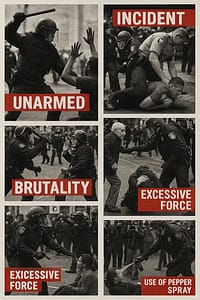
The disturbing footage of excessive police force that circulates across the world is rarely the product of sudden madness. These are not isolated “bad days.” They are the inevitable surfacing of traits that should have been screened out at the very beginning.
Stress is not an exception in law enforcement. It is the daily reality. Officers and soldiers are tested in environments where provocation is constant, tempers flare, and fear is contagious. In those split seconds where judgment matters most, the unfit show themselves. They reach for the baton instead of their voice, the trigger instead of restraint, punishment instead of protection.
The brutality that emerges in these critical moments is not just the failing of an individual. It is the proof of a system that chose not to assess deeply enough.
Assessment as a Shield, Not a Barrier
Too often, assessment is framed as a bureaucratic inconvenience, a delay in getting bodies into uniforms. But the truth is the opposite. A rigorous assessment is not a barrier to filling positions, it is a shield for society.
By systematically screening candidates for empathy, conflict de-escalation, emotional regulation, and accountability, law enforcement institutions ensure that those who wear the uniform deserve the trust that comes with it. This is not about lowering standards. It is about raising them, moving from hiring for compliance to hiring for conscience.
The strongest forces are not those filled with unquestioning obedience, but those staffed by individuals who know when to act, when to hold back, and when to recognize that humanity matters more than domination.
The responsibility for these failures does not rest only on the individuals who commit acts of brutality. It rests with leadership. Every hire is a reflection of institutional values. Every unchecked personality flaw that enters the force is tacitly approved by the system that let it through.
Leaders who focus narrowly on filling ranks ignore the deeper costs of poor assessment. They may believe speed solves shortages, but the hidden costs are devastating: lawsuits, destroyed community relations, citizens who no longer cooperate, officers who no longer feel safe in the public eye. Once trust is broken, no reform campaign or PR initiative can restore it quickly.
Hiring for conscience is not optional. It is the only sustainable way to maintain legitimacy.
The Global Pattern of Failure
What we see in one country is echoed across borders. In militarized police units, in national forces, in local policing. Excessive force is not a matter of culture alone, it is a structural failure in recruitment and assessment. Nations that ignore this reality end up with headlines of brutality, protests in the streets, and citizens who view the uniform as a threat instead of a safeguard.
And once brutality becomes normalized, it spreads. Younger recruits absorb the culture, convinced that aggression equals respect.
Veterans look the other way. Institutions bend inward, protecting their own instead of protecting the people. It is a vicious cycle, and it always begins at the door of recruitment.
The Lesson for All Employers – The Trust
The stakes are highest in policing and military institutions, but the lesson carries across every field. Workplaces that ignore character in hiring invite manipulators, aggressors, and unaccountable individuals into positions of influence. In offices, this may mean toxic managers. In government, it may mean corrupt officials. In law enforcement, it means lives lost and trust destroyed.
The principle is the same: assessment is the firewall. Skip it, and the wrong people will enter. Once inside, they will reshape the culture to fit their flaws.
At the end of the day, the legitimacy of any institution, whether a state, a military force, a police unit, or a company, rests on one fragile currency: trust. People do not measure worth only in numbers, statistics, or efficiency. They measure it in the restraint leaders show when power could be abused, in the fairness of decisions that affect lives, and in the respect extended even to those who disagree, dissent, or stand accused.
When trust is broken, societies fracture, organizations crumble, and cooperation evaporates. Citizens stop engaging, employees disengage, and every mission or operation becomes harder, riskier, and more dangerous. Without trust, a uniform is just fabric, a badge just metal, and a corporate logo just ink.
This is why assessment cannot be dismissed as a bureaucratic formality. It is the foundation upon which credibility is built. It decides whether the public sees authority as protective or predatory, whether employees see leadership as empowering or exploitative, and whether the larger system is experienced as just or corrupt. Assessment marks the thin but vital line between respect freely given and compliance forced through fear.
Everyone has already witnessed the consequences of failed hiring. We see them splashed across newspapers, broadcast live in shocking videos, or dissected in international reports. The patterns are obvious: when the wrong person is placed in the wrong job, especially one carrying authority, the outcome is not just inefficiency. It is brutality, corruption, collapse of trust, and in the worst cases, loss of life.
Not everyone is suited for every job. That is not a weakness; it is a fact of human design. People thrive when their roles align with their skills, values, and conscience. They falter, and often cause damage, when placed where they should never have been in the first place. To ignore this truth is reckless. To deny it is dangerous.
The cost of misplacement can be catastrophic in policing or the military, but even in business it means profit lost, culture corroded, and reputations destroyed. The lesson is universal: assessment is not optional, it is the only safeguard against giving authority to those who should never hold it, and the only way to ensure that people serve where they are truly fit to serve.