

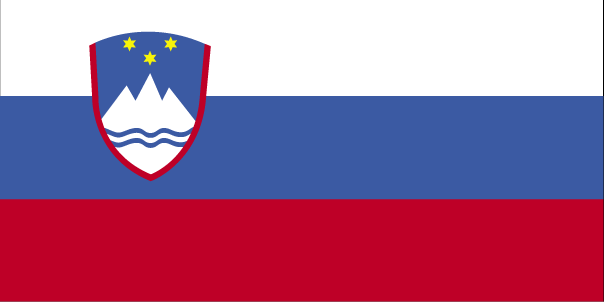
Country Language
Slovene
Country Currency
(EUR) Euro
Location
Country Labor Law References & Information
| Law | Description | Official Source |
|---|---|---|
| Zakon o delovnih razmerjih (ZDR-1)(Employment Relationships Act) | The principal legislation governing employment relationships, including contracts, working conditions, termination procedures, and workers’ rights. | gov.si |
| Zakon o javnih uslužbencih (ZJU)(Public Employees Act) | Regulates employment relationships of public sector employees, detailing rights and obligations specific to public service. | gov.si |
| Zakon o varnosti in zdravju pri delu (ZVZD-1)(Health and Safety at Work Act) | Establishes measures to ensure safe and healthy working conditions, including risk assessments and preventive measures. | gov.si |
| Zakon o pokojninskem in invalidskem zavarovanju (ZPIZ-2)(Pension and Disability Insurance Act) | Governs the pension and disability insurance system, outlining contributions, entitlements, and benefit calculations. | gov.si |
| Zakon o urejanju trga dela (ZUTD)(Labour Market Regulation Act) | Regulates employment services, unemployment benefits, and active labour market policies. | ess.gov.si |
| Zakon o zaposlitveni rehabilitaciji in zaposlovanju invalidov (ZZRZI)(Vocational Rehabilitation and Employment of Persons with Disabilities Act) | Promotes the employment of persons with disabilities through vocational rehabilitation and incentives for employers. | gov.si |
| Zakon o varstvu osebnih podatkov (ZVOP-1)(Personal Data Protection Act) | Regulates the protection of personal data in employment relationships, ensuring privacy and data security. | gov.si |
🏛️ Labour Relations Regulatory Institutions in Slovenia
| Institution | Role | Website |
|---|---|---|
| Ministry of Labour, Family, Social Affairs and Equal Opportunities | Oversees labour policies, employment relations, and social welfare programs. | gov.si |
| Labour Inspectorate of the Republic of Slovenia | Ensures compliance with labour laws and regulations through inspections and enforcement actions. | gov.si |
| Employment Service of Slovenia (ZRSZ) | Provides employment services, job matching, and unemployment benefits. | ess.gov.si |
| Pension and Disability Insurance Institute of Slovenia (ZPIZ) | Manages pension and disability insurance programs. | zpiz.si |
| Health Insurance Institute of Slovenia (ZZZS) | Administers the mandatory health insurance system. | zzzs.si |
Labour Legislation in Slovenia
Slovenia’s labour legislation is grounded in a civil law system and harmonized with international standards. Key aspects include:
Employment Contracts: Must be in writing and detail compensation, working hours, rest periods, job descriptions, and termination procedures.
Working Hours: Standard working hours are 40 hours per week, with provisions for overtime compensation.
Leave Entitlements: Employees are entitled to a minimum of four weeks of paid annual leave. Additional leave may be granted based on collective agreements or specific circumstances.
Sick Leave: Employees are entitled to paid sick leave, with compensation varying based on the cause and duration of the absence.
Parental Leave: In Slovenia, parental leave is designed to allow parents to care for their child immediately following maternity or paternity leave. Parental leave can be utilized by one parent or shared between both parents.
Minimum Wage: Determined annually by the government and published in the Official Gazette.
Occupational Health and Safety: Employers are obligated to ensure safe and healthy working environments, adhering to occupational health and safety regulations.
Anti-Discrimination: Slovenia prohibits discrimination in employment based on various grounds, including race, religion, sex, sexual orientation, disability, age, political opinion, or trade union membership. Enforcement mechanisms are in place to address violations.
Social Security: The social insurance system covers health care, pensions, unemployment benefits, and other welfare services, managed by respective state funds.
The Most Popular Job Boards in Slovenia
| Platform | Link | Description |
|---|---|---|
| MojeDelo.com | mojedelo.com | The largest and most visited job portal in Slovenia, offering a wide range of job listings across various industries. |
| Optius.com | optius.com | A popular job board providing job advertisements, career advice, and employer branding services. |
| Deloglasnik.si | deloglasnik.si | Part of the Alma Career Group, this platform offers job listings and access to an applicant tracking system. |
| Zaposlitev.info | zaposlitev.info | A job portal featuring various employment opportunities and career resources. |
| Inzaposlitev.net | inzaposlitev.net | Offers affordable job postings with promotion on social media platforms. |
| ZRSZ (Employment Service of Slovenia) | ess.gov.si | The official government portal for employment services, including job postings and career guidance. |
| LinkedIn Jobs | linkedin.com/jobs | A global professional networking platform with job listings in Slovenia. |
| Jooble Slovenia | jooble.org | An international job aggregator featuring Slovenian job postings. |
Slovenia’s employment ecosystem is well-supported by a combination of public and private job platforms, providing a strong digital infrastructure for recruitment across industries and professional levels.
MojeDelo.com stands out as the leading national job portal, widely used by employers and job seekers alike. It offers comprehensive listings, employer profiles, and career development resources. Platforms like Optius.com, Deloglasnik.si, and Zaposlitev.info offer similar services, supporting job searches with a mix of local listings, hiring tools, and recruitment marketing options.
The Employment Service of Slovenia (ZRSZ) serves as the official public platform, providing a centralized resource for active job seekers. Through its portal, individuals can access job listings, vocational training opportunities, and state-sponsored employment support.
For targeted outreach and passive candidate search, Slovenian professionals also rely on LinkedIn Jobs, while Jooble aggregates postings from multiple local sources. Inzaposlitev.net and JobRank Slovenia cater to niche or budget-conscious employers and job seekers looking for curated access.
Together, these platforms form a diverse and accessible job market environment in Slovenia, effectively connecting employers with domestic and international talent.
Recruiting & Hiring in Slovenia
Before initiating the recruitment process in Slovenia, employers must ensure compliance with the country’s anti-discrimination and data protection laws. Slovenia has adopted robust legal provisions aligned with EU directives, particularly through the Employment Relationships Act (ZDR-1) and the Personal Data Protection Act (ZVOP-1), which prohibit discriminatory practices and regulate the processing of personal data.Under Slovenian law, employers are strictly prohibited from discriminating against job applicants or employees based on personal characteristics such as gender, age, ethnicity, race, skin colour, language, religion or belief, disability, sexual orientation, marital status, family responsibilities, social status, political or other opinion, national or social origin, property status, education, or membership in a trade union or political group. Discrimination is not only prohibited during employment but also at all stages of the recruitment process, including the drafting of job advertisements, interviews, and candidate selection. Employers must ensure that all communications, written or verbal, avoid language or questions that could be construed as discriminatory unless those attributes are essential to the job’s performance (e.g., language proficiency for specific roles).
Slovenia also enforces strong data protection rules that mirror the General Data Protection Regulation (GDPR). When recruiting, employers should limit their collection of personal data to what is strictly necessary for evaluating a candidate’s qualifications and suitability for the role. Unjustified requests for sensitive information, such as marital status, family planning, or political affiliation, can constitute a breach of privacy rights.
In practice, job postings should be written in neutral, inclusive language and should focus solely on professional qualifications, experience, and competencies relevant to the position. During interviews, employers should refrain from asking personal questions unrelated to job requirements. Doing so not only ensures legal compliance but also helps build a fair and respectful hiring environment.
By aligning recruitment practices with Slovenia’s legal standards, companies position themselves as responsible employers while minimizing legal risks and promoting workplace equality.
Doing Business in Slovenia
Slovenian professionals are generally well-educated, multilingual, and internationally oriented. English is widely spoken, especially among younger generations and in urban centers, while German, Italian, Croatian, and Hungarian are also commonly understood, reflecting both historical ties and the influence of regional neighbors. Business culture in Slovenia values professionalism, direct communication, and mutual respect. While Slovenian companies tend to have relatively flat hierarchies, key decisions are still often made at the executive level, so it is important to engage with stakeholders who hold decision-making authority.
Establishing a business presence in Slovenia requires legal incorporation, which includes registering a local legal entity, securing a physical or virtual business address, opening a tax and bank account, and engaging a locally authorized accountant to ensure compliance with financial and employment regulations.
When hiring employees, proper job classification is critical. Slovenian labour law distinguishes clearly between full-time employment, part-time work, and freelance or contractor arrangements, each with different legal and tax implications. Misclassifying a worker, especially by treating an employee as a contractor to avoid statutory benefits, may result in legal penalties and retroactive obligations. Employers must also be attentive to the specific entitlements tied to employment types, such as social security contributions, health insurance, and paid leave provisions.
This page is intended as a general reference guide to the most commonly used job boards and key employment-related resources in the country, including links to local labor laws where available. While HR DADA strives to keep this information current, we update these listings periodically to reflect changes in market trends, platform relevance, and regulatory updates. For the most accurate and tailored guidance, whether for compliance, recruitment strategy, or HR market entry, we recommend reaching out directly to the HR DADA team via chat space.crew@hrdada.com.


