May 1st, known globally as International Workers’ Day or Labour Day, is observed in a wide variety of ways depending on a country’s historical, political, and cultural context.
The day has dual faces: one of protest and remembrance of workers’ struggles, and the other of springtime leisure and festivity.
Below is a breakdown of these two broad traditions and the countries associated with each, followed by the underlying reasons for the differences.

🔴 Countries Where May 1st is Marked by Protests, Demonstrations, and Political Activism
These countries traditionally honor May 1st as a day of labor solidarity, protest, and political awareness. The day is often used by trade unions, socialist and communist parties, or progressive political movements to highlight ongoing labor struggles.
1. France
- Tradition: Massive union-led protests, often with political overtones.
- Why: Deep-rooted socialist and workers’ rights history, especially post-1968 revolution.
2. Germany
- Tradition: Political rallies and union-organized demonstrations, especially in Berlin and Hamburg.
- Why: Strong union culture and historical ties to European socialist movements.
3. Italy
- Tradition: Both rallies and cultural events like the “Concertone” in Rome (a giant free concert).
- Why: Historic labor movements, strong leftist traditions.
4. Greece
- Tradition: Demonstrations often accompanied by strikes and anti-austerity protests.
- Why: Economic crises and a tradition of labor militancy.
5. Turkey
- Tradition: Protests, often met with police resistance in cities like Istanbul.
- Why: Long-standing tensions between labor movements and state institutions.
6. Russia and former Soviet countries
- Tradition: Official parades (in Soviet times) have given way to both protest and nationalistic demonstrations.
- Why: May Day was a major state-sponsored holiday during the USSR, originally rooted in workers’ rights.
7. Latin America (e.g., Argentina, Chile, Brazil)
- Tradition: Strong protest culture led by unions and leftist parties.
- Why: Labor movements have been central to political resistance and social justice.
🟢 Countries Where May 1st is a Day of Leisure, Nature, and Festivity
In many countries, especially in Central and Eastern Europe or parts of the Balkans, the day is used not primarily for political purposes but for picnics, barbecues, and springtime celebration. This is especially true in:
1. Serbia, Bosnia and Herzegovina, Montenegro, North Macedonia
- Tradition: Going to nature, grilling meat (especially ćevapi), drinking, socializing in parks or forests.
- Why: A cultural adaptation from socialist Yugoslavia that emphasized the celebration of labor through rest and social unity rather than protest.
2. Slovenia and Croatia
- Tradition: Similar to above, often less politically charged than in Western Europe.
- Why: Socialist legacy combined with deep-rooted springtime traditions.
3. Hungary, Slovakia, Czech Republic
- Tradition: Festivals, folk dancing, barbecues.
- Why: May Day was institutionalized as a state holiday under socialism, but the focus shifted to leisure over time.
4. Scandinavian countries (e.g., Finland, Sweden, Norway)
- Tradition: Mix of parades and festive traditions like Valborgsmässoafton (Walpurgis Night) on April 30.
- Why: Pagan spring festivals merged with labor celebrations.
⚪ Countries Where May 1st is Not a Major Holiday or Celebrated Differently
1. United States and Canada
- Tradition: Labor Day is celebrated on the first Monday in September, not May 1st.
- Why: The U.S. government intentionally distanced its Labor Day from May Day to avoid associations with socialism and the Haymarket Affair (which ironically occurred in the U.S. in 1886).
2. United Kingdom
- Tradition: May Day sometimes overlaps with a bank holiday and pagan traditions like Morris dancing, but labor protests are rare.
- Why: Political moderation and distinct historical development of labor rights.
📚 Why This Difference?
1. Historical-Political Legacy
- In countries with strong socialist or communist histories (e.g., Eastern Europe, Latin America), May Day became institutionalized as a state holiday, often without the protest element.
- In Western European democracies with active unions, the day retained its activist, confrontational character.
2. Cultural Traditions
- Pre-Christian spring festivals (e.g., Beltane, Walpurgis Night) became merged with May Day in several regions, giving the day a festive and naturalistic flavor.
3. State Strategy
- Some regimes (e.g., Yugoslavia) promoted leisure-based May Day celebrations as a way to unify people and soften political dissent, encouraging collective relaxation over protest.
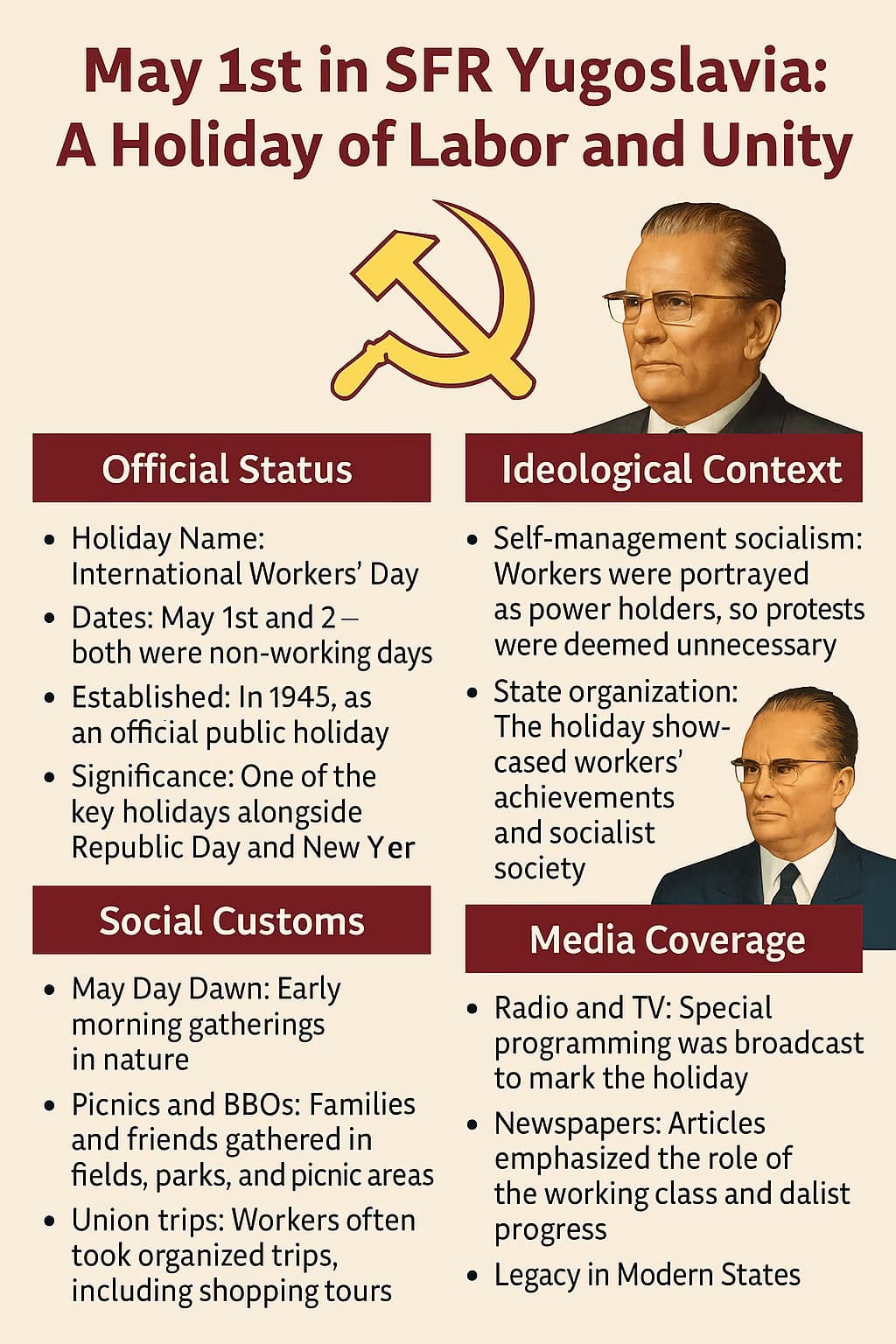
May 1st in “Ex SFR Yugoslavia”
Labor, Brotherhood, and Barbecue in Nature
In the Socialist Federal Republic of Yugoslavia (SFRY), May 1st – International Workers’ Day was one of the most important holidays of the year, not only politically, but also socially and culturally. What made the Yugoslav celebration unique compared to other communist or Western countries was the blend of ideology and popular tradition – labor rights were honored not through protests, but through collective rest, outings, and togetherness.

🔧Ideological Background
Yugoslav socialism, also known as self-managing socialism, promoted the image of the worker not as an oppressed figure, but as the holder of power and a builder of society.
Accordingly:
- There was no need for protests, since the state claimed to already protect the workers’ interests.
- May Day was a celebration, not a struggle – because “the worker was already in power” through worker councils and participatory management.
Therefore, it was rare to see protest marches on May 1st in Yugoslavia – instead, state-organized celebrations were the norm.
🏞️ Cultural Aspect
What has remained deeply rooted in the people to this day is the tradition of going into nature. In SFR Yugoslavia, this had both symbolic and practical significance:
- Collective spirit and “brotherhood and unity”: Families, friends, neighbors – even companies – organized group outings in parks, forests, and picnic areas.
- Celebrating labor through rest – the message was: “The worker has earned their rest, and it should be shared collectively.”
🔸 The most common activities included:
- Grilling (ćevapi, skewers, sausages)
- Drinking (beer, rakija), often with live folk music
- Flags and badges with Tito’s image
- In cities: official events, parades, and cultural programs
🏛️ State-Sponsored Celebration
The state played a very active role in organizing May Day celebrations:
- Workers’ resorts and unions often provided discounts or organized trips.
- TV and radio programs on May 1st focused on workers and their achievements.
- Political messaging: May Day was an opportunity to publicly affirm loyalty to the ideas of socialism and unity.
📻 Media and Public Messaging
May 1st in Yugoslavia was always accompanied by high-profile media coverage:
- Morning programming often began with patriotic songs and greetings to workers.
- Newspapers featured front pages celebrating the working class.
- Documentaries and reports praised achievements in industry, agriculture, and worker solidarity.
🟢 Legacy in Post-Yugoslav Countries
Even after the breakup of Yugoslavia, the spirit of the “Yugoslav May Day” lives on. In most of the former republics, the holiday is still celebrated in a very similar way:
| Country | Status today | How it’s celebrated |
|---|---|---|
| 🇷🇸 Serbia | Public holiday | Outings, barbecue, socializing, some protests |
| 🇧🇦 Bosnia and Herzegovina | Public holiday | Nature, picnics, family gatherings |
| 🇲🇪 Montenegro | Public holiday | Like BiH, with local cultural events |
| 🇲🇰 North Macedonia | Public holiday | Music, picnics, informal parties |
| 🇭🇷 Croatia | Public holiday | Barbecues and smaller political gatherings |
| 🇸🇮 Slovenia | Public holiday | Cultural programs and outdoor leisure |
Even though the political systems have changed, the culture of collective rest and celebration in nature remains deeply embedded, and can be seen as one of the most vivid cultural legacies of Yugoslavia still connecting people today.