

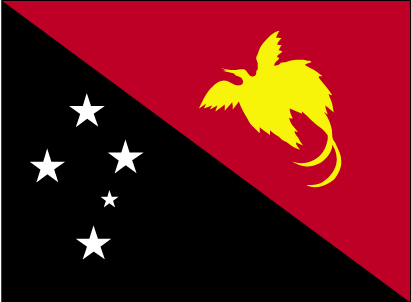
Country Language:
- English, used in government, law, education, and formal settings.
- Tok Pisin, a widely spoken creole and the main lingua franca.
- Hiri Motu, spoken mainly in southern regions, but less common today.
In addition, the country is home to over 850 indigenous languages, making it the most linguistically diverse nation in the world.
Country Currency:
(PGK) Kina
Location
Country Labor Law References & Information
| Law Title | Description | Official Source |
|---|---|---|
| Employment Act 1978 | The foundational statute covering employment contracts, wages, leave, termination, working hours, youth & maternity protections, housing, OHS, and dispute resolution. | https://www.labour.gov.pg/downloads/ https://www.gavman.gov.pg/organisations/personal-management-department-of |
| Industrial Relations Act 1962 | Outlines procedures for collective bargaining, dispute resolution, and establishes the Industrial Conciliation & Arbitration Tribunal and Minimum Wages Board. | https://www.parliament.gov.pg/bills-and-legislation |
| Employment of Non‑Citizens Act 2007 (Amended 2021) | Regulates work permits, employer obligations, local-first hiring, and language requirements for foreign workers. | https://www.parliament.gov.pg/bills-and-legislation |
| Workers’ Compensation Act 1978 | Establishes statutory provisions for occupational injuries and employer responsibilities for compensation. | https://www.parliament.gov.pg/bills-and-legislation |
| Minimum Wages Board Regulations | Sets sector-specific minimum wages and youth wage scales under Industrial Relations legislation. | https://www.parliament.gov.pg/bills-and-legislation |
| Employment Regulation 1980 + Superannuation Act, PNG mandates employer/employee contributions through NASFUND | Provides administrative rules for domestic implementation of the Employment Act, covering contracts, wages, leave, and working hours. | https://www.parliament.gov.pg/bills-and-legislation |
| Apprenticeship & Training Levy Orders | Govern vocational training obligations, levy collection, and national apprenticeship standards. | https://www.parliament.gov.pg/bills-and-legislation |
🏛️ Institutions Overseeing Labour in PNG
| Institution | Role | Source / Reference |
|---|---|---|
| Department of Labour & Industrial Relations (DLIR) | Central agency overseeing employment laws, OHS, minimum wages, work permits, compensation, and dispute resolution. | labour.gov.pg overview |
| Industrial Conciliation & Arbitration Tribunal | Resolves industrial disputes and hears unfair dismissal and collective bargaining matters. | DLIR Statutory Offices |
| Minimum Wages Board | Sets minimum wage benchmarks, including youth wage levels. | DLIR Statutory Offices |
| Office of Workers’ Compensation | Administers claims for workplace injury compensation. | DLIR Statutory Offices |
| National Training Council & Apprenticeship Board | Regulates vocational training standards, levy schemes, and trade certification. | DLIR Statutory Offices |
| Office of the Industrial Registrar | Manages registration of trade unions and employer associations. | DLIR Statutory Offices |
| National Tripartite Consultative Council (NTCC) | Facilitates national dialogue among government, employers, and unions. | DLIR Statutory Offices |
📝 Labour Law in Papua New Guinea
Papua New Guinea’s labour law system is rooted in a formal legal framework designed to regulate employment relationships, promote industrial harmony, and protect workers’ welfare. Anchored in the Employment Act 1978, the country’s employment regulation addresses both individual and collective labour rights while recognising the social and economic particularities of a diverse, resource-based economy.
The Employment Act provides the foundational structure for defining employment contracts, setting out entitlements such as leave, wages, and working hours. It introduces protections for specific worker groups, including youth and pregnant employees, and obligates employers to ensure health and housing standards where applicable. The Employment Regulation 1980 supplements this by outlining procedural obligations such as written contract formats, record keeping, and wage notices, providing greater administrative clarity and enforcement potential.
Industrial relations are further regulated by the Industrial Relations Act 1962, which creates a structured approach to collective bargaining and dispute resolution. Through this Act, the Industrial Conciliation and Arbitration Tribunal and the Minimum Wages Board were established, institutionalising dialogue between workers, employers, and the state. These bodies enable sector-wide agreements, adjudicate unfair dismissal cases, and periodically review statutory wage levels.
For workplace injuries and occupational health, the Workers’ Compensation Act 1978 mandates employer liability and offers statutory compensation procedures. This is complemented by emerging standards in occupational safety, driven by the Department of Labour and Industrial Relations’ (DLIR) OSH programmes, which, though not yet consolidated in a standalone law, are progressively embedded through administrative guidelines.
The Employment of Non-Citizens Act 2007, most recently amended in 2021, governs the conditions under which foreign workers may be employed. It places strong emphasis on localisation policies, requiring employers to demonstrate training efforts for nationals and adhere to strict work permit controls. These regulations reflect a broader economic agenda of capacity building and equitable participation in national development.
Training and skills development are legally supported through the Apprenticeship and Training Levy Orders, under which employers contribute financially to vocational education and are required to comply with certified standards of on-the-job training. In parallel, superannuation obligations under the NASFUND framework establish mandatory employer and employee contributions for long-term social protection, further embedding employment within a lifecycle approach to social security.
Taken together, Papua New Guinea’s labour legislation constitutes a legally formalised system with moderate administrative enforcement, tripartite social dialogue mechanisms, and targeted protections for vulnerable categories. While regional disparities and informal employment remain structural challenges, the legal framework provides a clear basis for contractual employment, dispute prevention, and national workforce development.
The Most Popular Job Boards in Papua New Guinea
| Platform | Link | Description |
|---|---|---|
| PNGWorkforce.com | pngworkforce.com | PNG’s most active private portal with regional coverage, technician, manager, NGO, and trade roles. |
| LinkedIn Jobs – PNG | linkedin.com/jobs | For mid-to-senior professionals, mining, engineering, finance, NGO, and corporate vacancies. |
| Indeed – PNG | indeed.com.au/q-Papua-New-Guinea-jobs.html | Global aggregator with listings for regulatory affairs, project roles, and support functions. |
| Job.onepng.com – Jobs & Scholarships PNG | job.onepng.com | Private board featuring local jobs and scholarship opportunities across multiple sectors. |
| PNG Recruitment Box (Facebook) | Facebook group | Informal networking hub for diverse job announcements, flexible, grass-roots, and mobile-friendly. |
| IRC Careers – Revenue Commission | irc.gov.pg | Government enterprise portal for mid-level to senior roles in taxation and revenue administration. |
Navigating the Job Market in Papua New Guinea
Papua New Guinea’s job market is a dynamic ecosystem influenced by formal regulation, digital fragmentation, and community-driven hiring channels. Whether you’re a company aiming to recruit talent across Port Moresby, Lae, or the Highlands, or a job seeker looking to enter PNG’s public or private sectors, success depends on knowing which platforms to use, and how to use them effectively.
Papua New Guinea’s recruitment space combines formal digital platforms, international portals, and informal but highly active community-based networks.
Multi-Channel Hiring with Local Sensitivity
Recruitment in PNG demands a dual lens, regulatory compliance for formal roles, and creative sourcing for diverse or remote positions.
For technical, trade, or project-based roles, PNGWorkforce.com and Indeed provide broad reach and an established audience. Be concise and clear, local candidates appreciate transparency in job details, salaries, and contract types.
In sectors like banking, mining, development, and management, LinkedIn offers access to credentialed professionals and expatriate returnees. Employers should enhance their company profile and consider bilingual messaging to attract wider applicants.
Many PNG-based employers use PNG Recruitment Box to quickly fill roles in retail, logistics, or support functions. It’s a low-cost, high-engagement channel, ideal when looking for candidates in areas with less internet infrastructure
🎯 For Job Seekers…
Navigating PNG’s job market means knowing where opportunities are posted, and how to stand out.
Start with PNG Workforce.com and Indeed, these are the most consistently updated platforms. Job seekers should upload a concise, professional CV (ideally under 2MB), include all relevant certifications, and check listings at least twice per week.
Build your LinkedIn profile, even if roles aren’t listed there, recruiters and HR managers often search profiles after receiving an application. Keep it clean, highlight sector-specific experience, and clearly state your location and availability.
Use Facebook groups for real-time openings, informal and community-focused, PNG’s Facebook job groups often list jobs before they appear on any website. These roles might include fewer application barriers, but competition is high. Apply promptly and follow up directly when appropriate.
This page is intended as a general reference guide to the most commonly used job boards and key employment-related resources in the country, including links to local labor laws where available. While HR DADA strives to keep this information current, we update these listings periodically to reflect changes in market trends, platform relevance, and regulatory updates. For the most accurate and tailored guidance, whether for compliance, recruitment strategy, or HR market entry, we recommend reaching out directly to the HR DADA team via chat space.crew@hrdada.com.
